
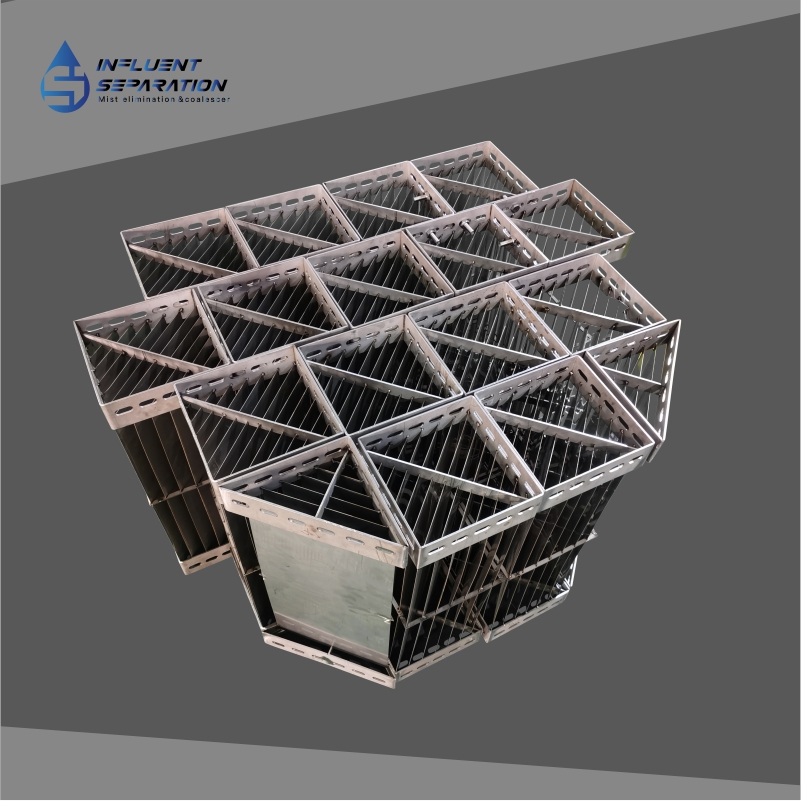
Plate Pack Separator Media
03/15/2023
Droplet Separator
03/20/2023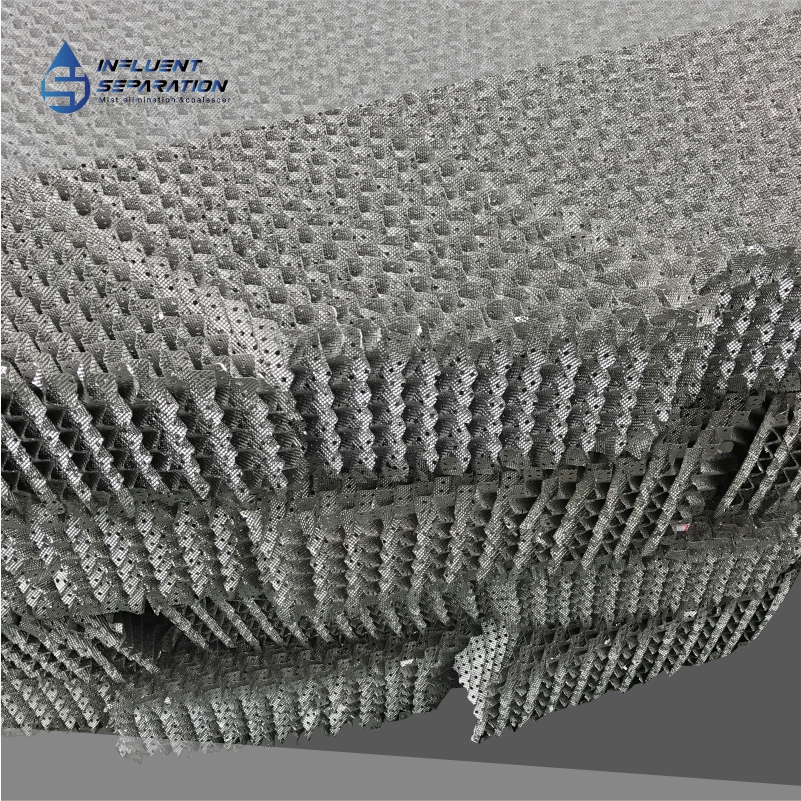
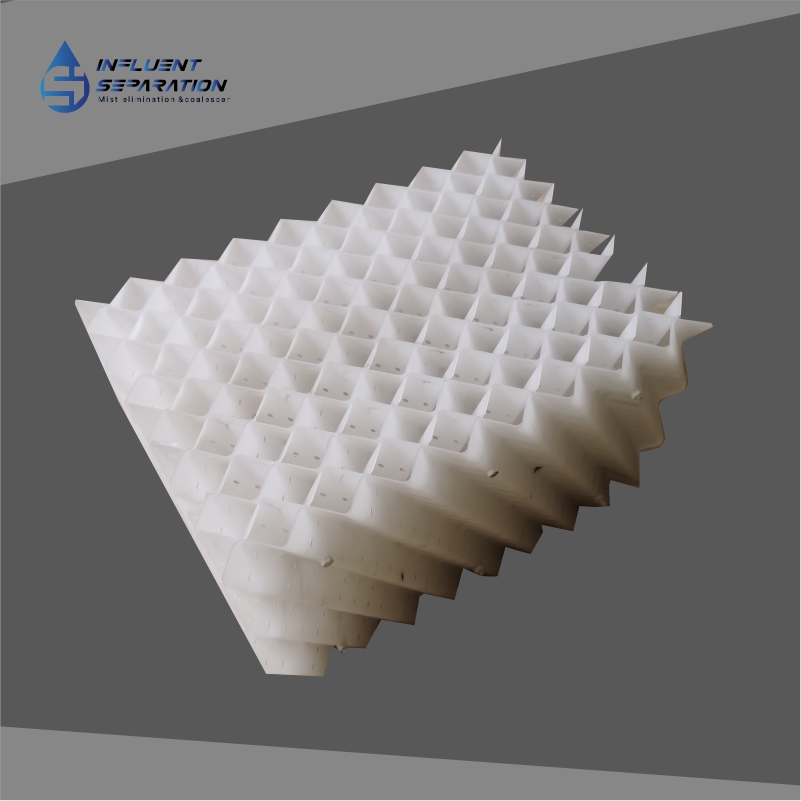
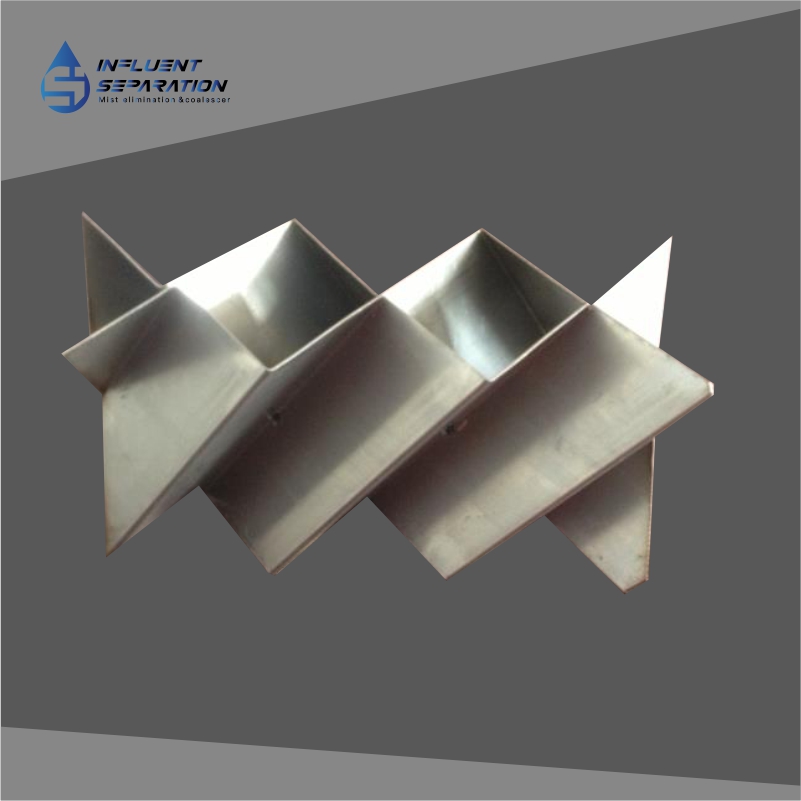
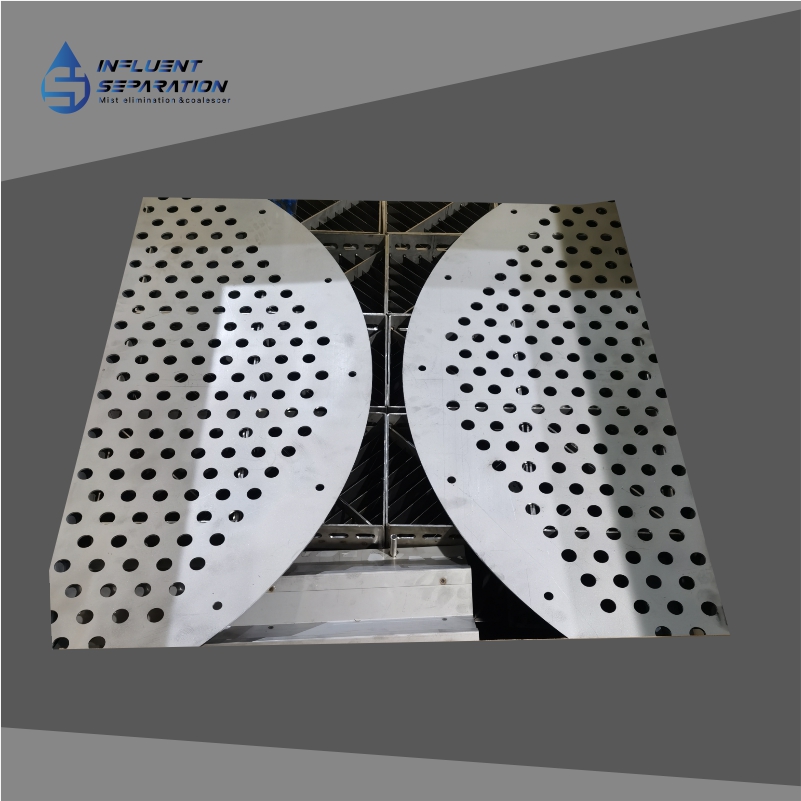
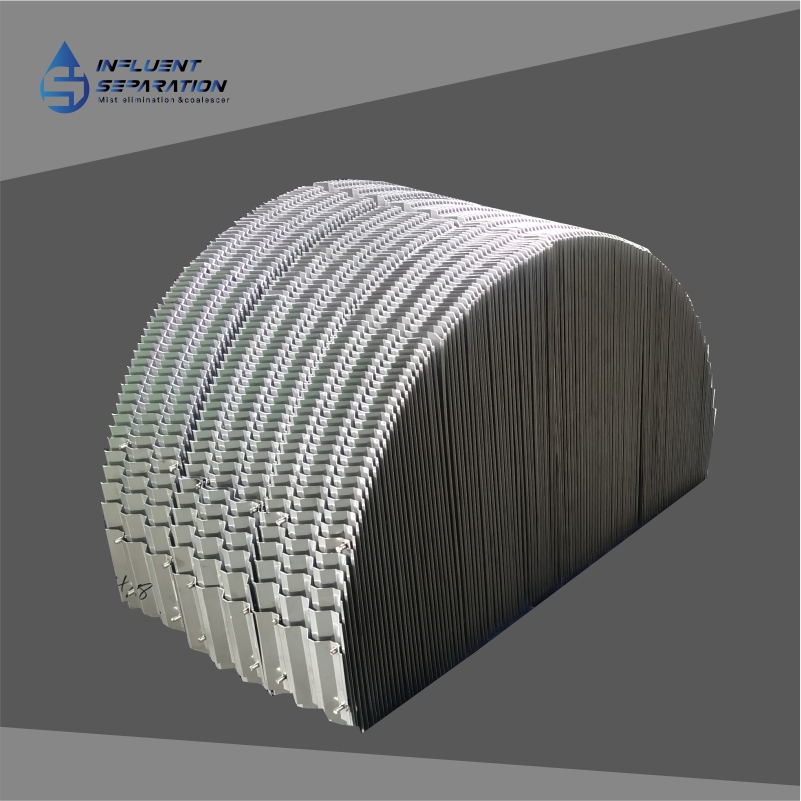
Corrugated Plate Separator Media
Item Name: Corrugated Plate Separator Media
Materials of Construction
• Stainless steel, duplex steel
2205,2507,254SMO
• Alloy C276, 400, 625, 825, 20, etc…
• Plastics (PP, PVDF)
Function:
A corrugated sheet of liquid-liquid settling media is selected as a first-stage device. This device
minimizes the turbulence effects by dividing the stream into a number of separate chambers, which
provides four (4) primary benefits:
(1) decreases the effective diameter, thereby greatly reducing the Reynolds number of the flowing fluid and producing a deep laminar flow environment that enhances the gravity settling rate.
(2) isolates the fluid in separate channels, thereby putting limits on how far droplets can “wander” and reducing the negative impact of eddy currents.
(3) decreases the distance a droplet needs to rise or fall before reaching an interface, thereby greatly lowering the settling time requirement.
(4) provides multiple interfaces inside the equipment where droplets can coalesce, thereby greatly affecting the coalescing process.
Frequently Asked Questions
What is plate pack separator media used for?
What is the difference between plate pack and corrugated plate media?
How are plate packs sized?
Which materials are plate pack separators made from?
- A corrugated plate pack is a coalescer, not a filter: it only works on droplets that can rise, in practice 60 µm and larger for a CPI-style pack, against roughly 150 µm for a plain API separator.
- Sizing starts from Stokes rise velocity, not from a catalogue flow rate: at 60 µm, oil at 850 kg/m³ in water at 20 °C rises at about 0.3 mm/s, so 10 m³/h needs on the order of 9 m² of projected area before any efficiency factor.
- Plate spacing, inclination and corrugation pitch set the plate loading; the pack fouls when the oil layer is asked to move further than the plate is long.
What the pack actually does
A corrugated plate pack does one job: it shortens the distance an oil droplet has to travel before it meets a surface. In an open separator a 60 µm droplet needs a rise path measured in metres and a residence time measured in hours. Between plates spaced 6 to 12 mm apart, the same droplet needs a path measured in millimetres and a residence time measured in tens of seconds. The plates do not remove oil; they give the droplet a place to arrive.
That distinction matters at the specification stage. A pack quoted on flow rate alone is being sold as a filter it is not. A pack quoted on projected area, droplet cut size and plate loading is being sold as what it is.
Sizing from Stokes, not from a flow rate
Rise velocity for a droplet in the Stokes range:
v = g d² (ρw − ρo) / (18 µ)
With g = 9.81 m/s², water at 1000 kg/m³ and 0.001 Pa·s, and oil at 850 kg/m³:
| Droplet | Rise velocity | Projected area for 10 m³/h |
|---|---|---|
| 150 µm | 1.84 mm/s | 1.5 m² |
| 100 µm | 0.82 mm/s | 3.4 m² |
| 60 µm | 0.29 mm/s | 9.5 m² |
| 40 µm | 0.13 mm/s | 21 m² |
The table is the whole argument for why a plate pack exists: halving the droplet size quadruples the area. Below about 40 µm the area becomes unreasonable and the answer is a different device, not a denser pack.
Geometry that decides whether it works
- Spacing 6–12 mm. Tighter spacing raises the area per unit volume and raises the fouling rate with it. Solids-bearing water wants the upper end.
- Inclination about 45°. Shallow enough to keep the oil film moving to the collection trough, steep enough that the film does not re-entrain. Cross-flow packs run closer to 60° and trade area for drainage.
- Corrugation pitch and depth. The corrugation is what makes the path three-dimensional: it forces the droplet to cross the gap repeatedly instead of drifting along one plate. Pitch is chosen so the droplet cannot follow a straight line between plates.
- Plate length versus film load. A plate that is too long for the oil rate lets the film thicken until the pack re-entrains what it collected. Length is a drainage decision before it is an area decision.
Materials and fouling
Polypropylene is the default for produced water and general oily waste: cheap, inert, and easy to cut. Stainless is chosen where temperature, hydrocarbon solvents or sand loading rule PP out. The material decision is secondary; the fouling decision is primary. A pack that fouls in six months has the wrong spacing, not the wrong polymer.
Two field symptoms are worth knowing. Oil appearing downstream at design flow means the pack is bypassing, usually a damaged or displaced module. Oil appearing only above design flow means the pack is at its limit and the answer is area. Oil appearing at low flow means the upstream distribution has stopped working and part of the pack is seeing a short-circuit.
What to specify
- Design and turndown flow, in m³/h.
- Droplet size the duty actually requires, and where that number comes from.
- Oil density and viscosity at operating temperature, not at 20 °C.
- Solids loading and whether backwash is available.
- Module dimensions and how they are to be handled, because a pack that cannot be lifted out for cleaning becomes a permanent fouling site.
Related: plate pack separator media, problems that start outside the vessel, the selection map by duty.
Frequently asked questions
Can a corrugated plate pack remove free oil below 40 µm?
Not economically. Below roughly 40 µm the projected area required grows faster than any reasonable vessel, and the correct device is a flotation unit or a coalescing filter, not a tighter pack.
Does tighter plate spacing improve separation?
It improves area per unit volume and worsens fouling. With solids present, the tighter pack plugs sooner and the gain is lost.
Why does the pack work at design flow and fail above it?
Plate loading scales with flow. Above the design point the film thickens and re-entrainment starts; the pack has not changed, the duty has.
What plate angle should be specified?
About 45° for most oily water, closer to 60° for cross-flow packs where drainage matters more than area. The angle is set by the oil film, not by the drawing.
You must be logged in to post a review.
Reviews
There are no reviews yet.